
How Much Does a 40ft Shipping Container Cost in UAE? Connect with +971 50 285 7574 Pearltainer.com for best pricing.
A 40ft shipping container is one of the most practical investments for businesses requiring large-capacity cargo transportation, industrial storage, warehousing support or container-based infrastructure. Across the United Arab Emirates, demand for 40ft containers comes from shipping lines, freight forwarders, construction contractors, manufacturers, warehouses, distributors and commercial operators looking for dependable equipment with a long operational service life.
However, the price of a 40ft shipping container in the UAE is not determined by length alone. Its manufacturing condition, structural integrity, container height, flooring specification, previous service history, certification status, intended application and delivery requirements can significantly influence the final purchase cost.
As an indicative November 2026 UAE market guide, a used 40ft standard dry container is commonly advertised around AED 8,000–13,000, while a one-trip unit is around AED 13,000–17,000. For a 40ft High Cube, indicative advertised ranges are approximately AED 7,000–15,000 for used units and AED 14,000–22,000 for one-trip or near-new units. These are market-reference figures, not fixed quotations. Actual prices depend on the individual unit, available inventory, supplier, specification and delivery location. VAT and transportation may be additional.
At Pearltainer FZE, the objective is to help customers identify container equipment that corresponds to their operational requirements, rather than selecting a unit simply because it carries the lowest advertised price. Whether the requirement involves a single storage container, multiple units for a logistics operation or a specialised industrial application, understanding the technical and commercial factors behind the price is essential.
How Much Does a 40ft Shipping Container Cost in UAE. How Much Does a 40ft Shipping Container Cost in UAE. How Much Does a 40ft Shipping Container Cost in UAE.
1. How Much Does a 40ft Shipping Container Cost in the UAE?
The purchase price of a 40ft shipping container in Dubai and the wider UAE varies according to the container type and condition.
The following figures provide a practical budgeting reference based on publicly advertised UAE supplier listings reviewed in November 2026.
| Container specification | Indicative advertised price |
|---|---|
| 40ft standard used container | AED 8,000–13,000 |
| 40ft standard one-trip container | AED 13,000–17,000 |
| 40ft High Cube used container | AED 7,000–15,000 |
| 40ft High Cube one-trip / near-new container | AED 14,000–22,000 |
Important pricing qualification: These figures are indicative purchase-price benchmarks, not guaranteed transaction prices or Pearltainer’s published selling prices. Some individual suppliers advertise lower ex-yard prices, while higher-specification or better-condition units may exceed these ranges. Obtain photographs and a specification for the actual container being offered before comparing quotations.
A significant distinction exists between an advertised container price and the complete cost of acquiring, transporting and positioning the equipment at your premises.
A purchase quotation should therefore identify:
- Container type, size and manufacturing specification.
- New, one-trip or used condition.
- Structural condition and available inspection information.
- Purchase price and applicable VAT.
- Yard collection or delivery charges.
- Crane, lifting or offloading requirements.
- Any modifications, repairs or accessories.
- Relevant documentation and certification requirements.
A commercially attractive quotation is one that clearly establishes the complete supply scope, not simply the lowest initial figure.
How Much Does a 40ft Shipping Container Cost in UAE. How Much Does a 40ft Shipping Container Cost in UAE. How Much Does a 40ft Shipping Container Cost in UAE.
2. Understanding the 40ft Shipping Container Specification
A conventional 40ft shipping container is designed around internationally established intermodal dimensions. The container’s dimensional classification, external measurements and ratings are addressed by ISO 668, while relevant detailed container specifications are covered by the ISO 1496 series.
The nominal 40ft designation represents the external length category. The actual usable internal dimensions are smaller because of the end frames, corner posts, wall construction, roof structure and flooring assembly.
For procurement purposes, buyers should distinguish between a standard-height container and a 40ft High Cube container.
40ft Standard Shipping Container
A standard 40ft dry container is generally used for general-purpose cargo, industrial storage, commercial inventory, construction materials and export shipments.
Typical nominal dimensions are:
| Parameter | Approximate dimension |
|---|---|
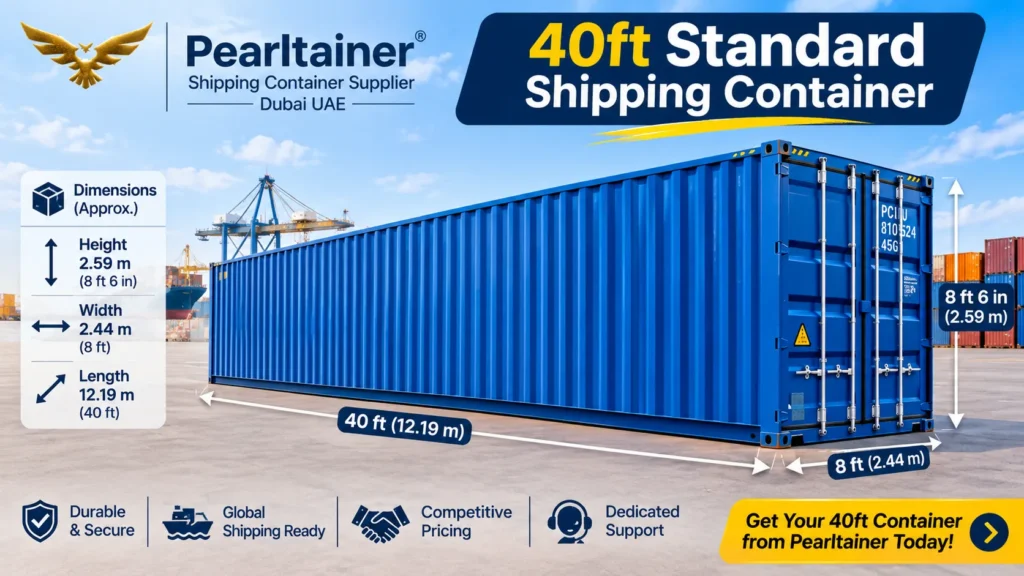
| External length | 12.19 m |
| External width | 2.44 m |
| External height | 2.59 m |
| Internal length | 12.03 m |
| Internal width | 2.35 m |
| Internal height | 2.39 m |
| Internal cubic capacity | 67.7 m³ |
| Door opening width | 2.34 m |
| Door opening height | 2.28 m |
40ft High Cube Shipping Container
A 40ft High Cube container retains approximately the same external length and width as a standard 40ft unit but offers an additional 305 mm (approximately one foot) of external height.
That additional vertical clearance can be useful for taller cargo, palletised products, bulky equipment, industrial inventory and selected container conversion projects.
| Parameter | Approximate dimension |
|---|---|
| External length | 12.19 m |
| External width | 2.44 m |
| External height | 2.90 m |
| Internal length | 12.03 m |
| Internal width | 2.35 m |
| Internal height | 2.69 m |
| Internal cubic capacity | 76.4 m³ |
| Door opening width | 2.34 m |
| Door opening height | 2.58 m |
Dimensions are representative nominal values. Actual clearances, capacity and weight ratings vary by manufacturer, model, construction and production year. Always confirm the individual unit’s data plate and technical drawing.
Why does High Cube cost more?
The additional height provides approximately 8.7 m³ of extra internal volume compared with a standard 40ft container, representing approximately 13% greater nominal cubic capacity.
This additional volume can improve space utilisation when the cargo geometry permits vertical stacking. For certain commercial applications, this can provide a better relationship between acquisition cost and usable storage volume.
However, High Cube is not automatically the correct selection for every operation. Door clearance, truck and route height restrictions, terminal handling requirements, site access and actual cargo dimensions must all be considered.
How Much Does a 40ft Shipping Container Cost in UAE. How Much Does a 40ft Shipping Container Cost in UAE. How Much Does a 40ft Shipping Container Cost in UAE.
3. What Factors Determine the Price of a 40ft Container?
Two containers carrying the same 40ft designation may have considerably different purchase prices. The commercial value of the unit is influenced by several interconnected technical and logistical factors.
3.1 Manufacturing condition and service history
A container that has recently left the manufacturing facility is generally more expensive than an older unit that has completed multiple transport cycles.
A one-trip container typically means that the unit has made one loaded voyage from its manufacturing or export origin. It is generally near-new in appearance and condition, although it is not technically identical to an unused container.
A used container may have completed numerous international shipping rotations. The extent of wear depends on its maintenance, handling history, exposure to marine environments and previous cargo applications.
For customers primarily requiring secure storage, a structurally sound weather-tight used container may offer a better cost-to-utility ratio than a new unit.
For customer-facing installations, demanding operations or projects where appearance and reduced repair requirements are priorities, a one-trip unit may be a more appropriate investment.
3.2 Structural integrity
Structural integrity is one of the most important considerations when purchasing a container.
The corner posts, corner castings, top and bottom side rails, cross-members, end frames and roof structure contribute to the container’s load-bearing performance.
Damage to these components can affect lifting, stacking, securing and transport suitability.
A container with repaired or distorted structural members should be evaluated carefully. Cosmetic paintwork should never be treated as evidence that the underlying structural condition is satisfactory.
The condition assessment should consider:
- Corner posts and corner castings.
- Top and bottom side rails.
- Cross-members and underframe.
- Roof panels and sidewall corrugations.
- End-wall construction.
- Door locking rods, hinges and locking cams.
- Flooring condition and moisture damage.
- Evidence of corrosion, impact or unauthorised modifications.
3.3 Corrosion and environmental exposure
UAE operating conditions can involve high ambient temperatures, humidity, airborne dust and coastal salt exposure.
These environmental conditions make corrosion inspection particularly relevant, especially for containers that have spent considerable time near marine terminals or exposed storage yards.
Rust staining on an external surface does not automatically establish structural failure. However, advanced section loss, perforation, deterioration around welds or corrosion affecting load-bearing members requires engineering attention.
A container purchased for long-term outdoor storage should have its roof, underframe, door end, corner fittings and lower sidewall sections examined closely.
3.4 Flooring specification
Most conventional dry containers use a heavy-duty timber-based flooring assembly supported by steel cross-members.
Before purchasing, examine the floor for delamination, cracking, contamination, moisture damage, soft areas and excessive wear.
The intended cargo is important. Industrial machinery may create concentrated point loads, while palletised cargo distributes its load differently across the floor.
Where high-density equipment or heavy industrial materials are involved, the permitted floor loading and cargo loading arrangement should be reviewed rather than assuming that the container’s maximum payload alone determines suitability.
3.5 Availability and inventory
Container prices are also influenced by available equipment in the regional market.
Factors such as shipping-line equipment repositioning, container availability, steel manufacturing costs, international freight movements and seasonal procurement demand can change the commercial pricing environment.
A supplier with immediate access to an appropriate unit may offer a different commercial proposition from a supplier sourcing the same specification from another location.
For project procurement, compare confirmed availability and the proposed delivery schedule alongside the purchase price.
How Much Does a 40ft Shipping Container Cost in UAE. How Much Does a 40ft Shipping Container Cost in UAE. How Much Does a 40ft Shipping Container Cost in UAE.
4. New, One-Trip and Used 40ft Containers: Which Should You Buy?
Choosing the right condition grade is often more important than negotiating a small reduction in the initial purchase price.
New or one-trip containers
These units are normally selected where appearance, cleaner internal surfaces and reduced previous service exposure are important.
Typical applications include:
- Commercial and retail storage installations.
- Customer-facing container modifications.
- Long-term equipment storage.
- Projects where a cleaner starting condition is preferred.
- Industrial applications requiring a well-preserved enclosure.
The higher acquisition cost may be justified when fewer initial repairs and a better presentation condition are commercially valuable.
Used cargo-worthy containers
A cargo-worthy container is generally represented as suitable for cargo transport, subject to the applicable inspection and documentation requirements.
For international shipping, buyers should confirm the CSC safety approval status, examination arrangements and acceptance requirements of the intended carrier or terminal.
A seller’s verbal description of a container as cargo-worthy should not replace verification of the actual unit and its relevant documentation.
Wind-and-water-tight containers
Wind-and-water-tight, frequently abbreviated as WWT, describes a used container that is intended to prevent normal wind and water penetration through its enclosure.
This condition description is commonly relevant to stationary storage applications.
WWT should not automatically be interpreted as equivalent to cargo-worthy, CSC-approved or suitable for international maritime transportation.
As-is containers
As-is containers may have significant corrosion, damage, flooring deterioration, defective doors or other issues requiring repair.
They can sometimes be appropriate for projects involving extensive modification or refurbishment, but the purchaser must account for repair costs, labour, materials and any engineering work before deciding that the low initial price represents genuine value.
Procurement recommendation: Select the condition category according to the operational purpose. A container intended for long-term outdoor storage does not necessarily require the same inspection and documentation profile as one intended for international freight transport.
How Much Does a 40ft Shipping Container Cost in UAE. How Much Does a 40ft Shipping Container Cost in UAE. How Much Does a 40ft Shipping Container Cost in UAE.
5. Delivery and Transportation Costs in Dubai and Across the UAE
The delivery component can make a noticeable difference to the final cost of a 40ft shipping container.
Unlike a small commercial delivery, transporting a 40ft container requires an appropriately configured vehicle, suitable handling arrangements and careful site coordination.
The quotation should identify the delivery method and whether positioning or offloading is included.
Delivery location
A container delivered within an accessible industrial area in Dubai may have a different transport cost from one delivered to a remote construction project, an industrial facility in Abu Dhabi or a location in another emirate.
Relevant destinations may include:
- Dubai and the Jebel Ali industrial and logistics areas.
- Sharjah industrial zones.
- Abu Dhabi and Mussafah.
- Ajman industrial areas.
- Ras Al Khaimah.
- Fujairah.
- Umm Al Quwain.
- Al Ain and other project locations.
The distance from the supply yard is only one part of the calculation. The route, vehicle configuration, access limitations and unloading arrangements must also be considered.
Transportation equipment
Depending on the collection and delivery arrangements, a 40ft unit may require a suitable flatbed, skeletal trailer or other compatible transport configuration.
Offloading can require a crane, an appropriate lifting arrangement or specialised delivery equipment.
The selected method must be compatible with the container’s lifting points, structural condition, total weight and the site installation arrangement.
Site access and ground conditions
Before dispatch, the purchaser should confirm:
- Adequate entrance width and turning clearance.
- Road and ground bearing capacity.
- Sufficient overhead clearance.
- Space for vehicle positioning and manoeuvring.
- Unloading equipment availability.
- A level and suitably prepared installation surface.
- Any site-specific access permissions or operating restrictions.
A delivery vehicle reaching the site does not necessarily mean the container can be safely positioned there.
For example, a narrow entrance, overhead obstruction, soft ground or insufficient crane working area can require additional planning and potentially additional costs.
For commercial procurement, it is advisable to provide the supplier with the site location, access photographs, unloading area and positioning instructions before confirming the transportation quotation.
How Much Does a 40ft Shipping Container Cost in UAE. How Much Does a 40ft Shipping Container Cost in UAE. How Much Does a 40ft Shipping Container Cost in UAE.
6. Is VAT Included in the 40ft Container Price?
The standard VAT rate in the UAE is 5%.
However, buyers should check whether an advertised price is inclusive or exclusive of VAT, and whether the transaction is subject to standard-rated VAT or another applicable tax treatment.
For illustration, assuming the sale is standard-rated and the quoted base price excludes VAT:
| Container price | VAT at 5% | Subtotal including VAT |
|---|---|---|
| AED 8,000 | AED 400 | AED 8,400 |
| AED 10,000 | AED 500 | AED 10,500 |
| AED 13,000 | AED 650 | AED 13,650 |
| AED 15,000 | AED 750 | AED 15,750 |
| AED 18,000 | AED 900 | AED 18,900 |
| AED 22,000 | AED 1,100 | AED 23,100 |
These calculations exclude delivery and other additional services.
A professional quotation should state the taxable supply value, applicable VAT and total amount payable so that the procurement department can prepare an accurate acquisition budget.
7. How Much Does a 40ft Refrigerated Shipping Container Cost?
A 40ft refrigerated container, commonly called a reefer container, is a specialised equipment category and should not be priced against the same benchmark as a conventional dry container.
A reefer integrates an insulated enclosure with a refrigeration system designed to maintain a specified cargo temperature within the equipment’s operating limits.
Depending on the application, a reefer may be used for temperature-controlled cargo transportation, chilled or frozen storage, food distribution and other suitable commercial applications.
Its acquisition price is influenced by considerably more than the external container structure.
Important technical pricing variables include:
- Refrigeration unit manufacturer and model.
- Compressor condition and operating hours, where available.
- Evaporator and condenser performance.
- Refrigerant circuit integrity.
- Controller condition and electronic diagnostics.
- Insulated panel and door-seal integrity.
- Temperature operating range.
- Available power supply and electrical configuration.
- Genset requirements for applications without fixed electrical supply.
- Service and maintenance history.
A buyer should request details of the refrigeration machinery, operating condition, available service records and relevant performance testing.
A reefer that looks clean externally is not necessarily an operationally sound refrigeration system.
For 40ft refrigerated containers, Pearltainer provides enquiry-based sales and rental options subject to availability and specification. The quotation should be based on the required temperature range, intended cargo, operating environment, power supply, unit condition and delivery arrangements.
A separate technical assessment is recommended when the unit is intended for temperature-sensitive products or continuous commercial operation.
How Much Does a 40ft Shipping Container Cost in UAE. How Much Does a 40ft Shipping Container Cost in UAE. How Much Does a 40ft Shipping Container Cost in UAE.
8. Understanding CSC Certification and Shipping Suitability
For customers intending to transport containers internationally, the International Convention for Safe Containers (CSC) is a particularly important consideration.
The CSC framework addresses the testing, inspection, approval and maintenance of covered freight containers.
An approved container carries a CSC Safety Approval Plate displaying relevant identification and technical information.
The purchaser should verify the plate and the applicable examination arrangement, including whether the container is maintained under an approved continuous examination programme or a periodic examination system.
The container’s physical condition must also be assessed. A plate should not be treated as proof that every component is currently damage-free.
Depending on the intended shipping route and carrier requirements, buyers should confirm:
- Whether the container is accepted for the intended international transport operation.
- Whether its CSC approval and examination status are current and verifiable.
- Whether the maximum gross mass and payload are suitable.
- Whether its physical condition meets the carrier’s acceptance requirements.
- Whether any modifications have affected its original structural or approved configuration.
A container purchased exclusively for stationary storage may have a different documentation requirement from a container intended for international intermodal use.
For this reason, the buyer should explain the intended application before selecting a unit.
How Much Does a 40ft Shipping Container Cost in UAE. How Much Does a 40ft Shipping Container Cost in UAE. How Much Does a 40ft Shipping Container Cost in UAE.
9. What Is the Maximum Payload of a 40ft Shipping Container?
The maximum payload of a 40ft container cannot be established reliably from its external dimensions alone.
The correct calculation is:
Maximum permissible payload = Maximum gross mass − Tare mass
Maximum gross mass is the permitted total mass of the loaded container, while tare mass is the weight of the empty container.
These values are recorded on the relevant container identification and safety information.
For example, if a unit has a maximum gross mass of 30,480 kg and a tare mass of 3,800 kg, its calculated payload is:
30,480 kg − 3,800 kg = 26,680 kg.
This is an illustrative calculation, not a universal rating for every 40ft container.
The actual permitted payload must be taken from the individual container’s data plate, and the complete transport arrangement must also comply with applicable vehicle, axle, road and carrier limits.
Payload alone does not establish whether a particular cargo is suitable. Cargo weight distribution, point loading, floor condition, securing arrangements and centre of gravity also influence safe operation.
For heavy industrial machinery, specialist equipment and dense materials, a loading and securing plan should be developed before the container is packed or transported.
How Much Does a 40ft Shipping Container Cost in UAE. How Much Does a 40ft Shipping Container Cost in UAE. How Much Does a 40ft Shipping Container Cost in UAE.
10. Should You Buy a 40ft Standard or 40ft High Cube Container?
The correct choice should be based on usable capacity, not simply the nominal dimensions or purchase price.
A 40ft standard unit can be suitable for general cargo, storage, machinery and goods that fit within its standard internal height and door clearance.
A 40ft High Cube is often more appropriate where vertical space is a priority.
Consider the following comparison:
| Selection criterion | 40ft Standard | 40ft High Cube |
|---|---|---|
| External height | Approximately 2.59 m | Approximately 2.90 m |
| Internal volume | Approximately 67.7 m³ | Approximately 76.4 m³ |
| Vertical clearance | Standard | Additional clearance |
| Tall cargo | More restrictive | More suitable |
| Bulk storage | Suitable | Greater nominal volume |
| Transport height | Lower | Higher |
For customers storing packaged inventory, pallets or bulky materials, the added height can improve usable storage volume.
For certain industrial applications, this additional capacity may help reduce the number of units required.
Nevertheless, the decision should take into account the cargo’s dimensions, stacking limits, forklift access, door opening, lifting arrangements and site limitations.
A 40ft High Cube should not be selected simply because it provides a larger cubic measurement. The actual cargo and operating requirements should determine the specification.
How Much Does a 40ft Shipping Container Cost in UAE. How Much Does a 40ft Shipping Container Cost in UAE. How Much Does a 40ft Shipping Container Cost in UAE.
11. Buying a 40ft Shipping Container for Industrial and Commercial Applications
The UAE’s commercial and industrial sectors use shipping containers for a wide variety of operational purposes.
Logistics and freight forwarding
Shipping companies and freight forwarders require suitable containers for general cargo, temporary storage and international transportation. Container condition, payload ratings, structural integrity and carrier acceptance are particularly important.
Construction and infrastructure projects
Construction companies use 40ft containers to secure building materials, tools, equipment and project inventory. Door security, weather protection, positioning and ground preparation are important selection considerations.
Warehousing and distribution
Warehouses and distribution businesses can use containers as additional storage capacity during expansion, inventory fluctuations or temporary space shortages.
A High Cube configuration may be useful for certain products requiring additional vertical clearance.
Manufacturing and industrial operations
Manufacturers may require containers for storing spare parts, components, tools, consumables and selected equipment.
Where machinery is stored, floor loading, ventilation, internal dimensions and safe access should be reviewed.
Retail and commercial operations
Businesses may use shipping containers as the structural base for selected commercial modifications and storage applications.
Any conversion involving cutting, welding, insulation, electrical services or structural modifications should be designed for the intended application rather than treated as a cosmetic alteration.
How Much Does a 40ft Shipping Container Cost in UAE. How Much Does a 40ft Shipping Container Cost in UAE. How Much Does a 40ft Shipping Container Cost in UAE.
12. Should You Buy or Rent a 40ft Container?
The decision between purchasing and renting depends on the expected period of use, capital allocation, maintenance responsibilities and project requirements.
Buying a container
Purchasing may be more appropriate where:
- The unit is required for long-term use.
- The business wants ownership of the equipment.
- The container will become part of permanent operational inventory.
- The unit may be relocated between projects.
- The organisation wants to assess future resale value.
Ownership also means the purchaser must plan for maintenance, inspections, storage, positioning and eventual disposal or resale.
Renting a container
Rental may be commercially preferable for temporary construction projects, short-term storage requirements, seasonal inventory needs and projects with uncertain duration.
A rental quotation should specify the rental period, monthly or other agreed charges, minimum commitment, delivery and collection, maintenance responsibilities, permitted use, damage liability and extension arrangements.
For a fair financial comparison, calculate the projected total rental expense across the entire intended period and compare it with the acquisition, transportation, maintenance and eventual resale cost of ownership.
The lowest initial financial commitment is not always the most economical long-term solution.
How Much Does a 40ft Shipping Container Cost in UAE. How Much Does a 40ft Shipping Container Cost in UAE. How Much Does a 40ft Shipping Container Cost in UAE.
13. What Should You Check Before Purchasing a 40ft Container in the UAE?
Professional procurement should include a technical and commercial verification process before payment and dispatch.
The following checklist is useful for both new and used container acquisitions.
Structural inspection
Check the container’s corner posts, castings, rails, cross-members, roof and end-frame condition. Look for deformation, severe corrosion, impact damage, compromised welds and evidence of previous structural repairs.
Door mechanism
Inspect hinges, locking bars, cams, handles, gaskets and door alignment. Doors should operate correctly and provide the required closure and access.
Roof and weather protection
Look for roof deformation, corrosion, holes, compromised seams and evidence of water ingress. For storage applications, verify the enclosure’s weather-tight condition.
Flooring condition
Inspect the flooring for cracks, delamination, moisture damage, soft areas, contamination and excessive wear. Confirm suitability for the anticipated load distribution.
Identification and documentation
Verify the container identification number, data plate, tare weight, maximum gross mass and other relevant technical markings. For international shipping, establish the CSC status and carrier acceptance requirements.
Delivery verification
Confirm the transport vehicle, collection point, destination, unloading method, access route and final placement arrangements.
Written quotation
Ensure the quotation specifies the exact unit category, condition, price, tax treatment, delivery scope, payment terms and any agreed inspection or documentation requirements.
A transparent procurement process reduces the risk of unexpected repairs, transportation complications and disputes after delivery.
How Much Does a 40ft Shipping Container Cost in UAE. How Much Does a 40ft Shipping Container Cost in UAE. How Much Does a 40ft Shipping Container Cost in UAE.
14. Why Request a 40ft Container Quotation from Pearltainer FZE?
Selecting a shipping container is an equipment procurement decision. The correct specification depends on the operational role the container will perform throughout its service life.
Pearltainer FZE provides container supply and related equipment enquiries for commercial, industrial, storage and logistics applications in Dubai and across the wider UAE.
The company’s product range includes standard marine containers, 40ft and High Cube options, new and used containers, refrigerated units, open-top containers, flat racks, insulated containers and selected specialised equipment, subject to availability.
Pearltainer also accepts enquiries for container rental and selected modular solutions.
Rather than relying on a generic price estimate, customers can share their technical and commercial requirements for assessment.
A useful quotation request should include:
- Required container size: 40ft standard or 40ft High Cube.
- Preferred condition: new, one-trip or used.
- Intended purpose: cargo transportation, storage or conversion.
- Quantity required.
- Cargo dimensions, approximate weight and loading arrangement.
- Certification or inspection requirements, where applicable.
- Delivery emirate and site location.
- Offloading and positioning requirements.
- Purchase or rental preference.
- Target delivery date or rental commencement date.
This information helps establish a more accurate equipment specification and quotation scope.
For customers with multiple locations or larger procurement requirements, sharing the complete project requirement at the beginning can also help the supplier assess quantities, equipment availability and logistics arrangements together.
A well-selected container should deliver the right balance of structural condition, usable capacity, operational suitability and total ownership cost.
15. Request Your 40ft Shipping Container Price in Dubai and UAE
Are you looking for a 40ft shipping container for sale in Dubai, Sharjah, Abu Dhabi or another UAE location?
Whether your requirement involves a standard dry container, a 40ft High Cube, a new or used unit, or a specialised container for an industrial application, Pearltainer can review your enquiry according to the required specification and current availability.
Share your container size, quantity, condition preference, intended use and delivery location to request a quotation.
How Much Does a 40ft Shipping Container Cost in UAE. How Much Does a 40ft Shipping Container Cost in UAE. How Much Does a 40ft Shipping Container Cost in UAE.
Pearltainer FZE — Your Ultimate Container Solution.
Website: https://pearltainer.com/
Sales enquiries: +971 6 553 6205
Email: info@pearltainer.com
How Much Does a 40ft Shipping Container Cost in UAE. How Much Does a 40ft Shipping Container Cost in UAE. How Much Does a 40ft Shipping Container Cost in UAE.
Frequently Asked Questions (FAQs)
1. How much does a 40ft shipping container cost in the UAE?
A used 40ft standard shipping container is commonly advertised around AED 8,000–13,000, while one-trip units are approximately AED 13,000–17,000. For a 40ft High Cube, indicative used prices are approximately AED 7,000–15,000, with one-trip or near-new listings around AED 14,000–22,000. Actual quotations depend on condition, availability, specification, VAT and delivery.
2. How much does a used 40ft container cost in Dubai?
Used 40ft standard containers are advertised around AED 8,000–13,000 in the UAE market. Used High Cube containers have a wider advertised range, approximately AED 7,000–15,000. The precise price depends on structural condition, flooring, corrosion, door operation, age and intended use.
3. What is the price of a new 40ft High Cube container in the UAE?
One-trip and near-new 40ft High Cube containers are advertised in an indicative range of approximately AED 14,000–22,000. The exact amount should be confirmed against the actual unit, manufacturing condition, supplier inventory, VAT and delivery requirements.
4. What is the difference between a 40ft standard and a 40ft High Cube?
Both containers have approximately the same external length and width. A standard 40ft container is approximately 2.59 m high externally, while a 40ft High Cube is approximately 2.90 m high. The High Cube provides approximately 13% more nominal internal volume.
5. Is VAT included in the advertised container price in the UAE?
Not always. Some supplier quotations are presented before VAT, while others may display tax-inclusive prices. The standard UAE VAT rate is 5%, subject to the applicable tax treatment. Buyers should confirm the VAT amount and total invoice value before purchase.
6. Is delivery included in the price of a 40ft shipping container?
Delivery is not necessarily included in an advertised container price. Transport, site positioning, crane or lifting arrangements, access limitations and offloading can be quoted separately. Ask the supplier for the complete delivered cost to your site.
7. Can a used 40ft shipping container be used for international shipping?
It may be suitable, but its condition and documentation must be verified. For international transportation, buyers should check the applicable CSC safety approval and examination status, structural condition, payload rating and acceptance requirements of the intended carrier.
8. What is the maximum payload of a 40ft container?
Payload varies by container construction and tare weight. It is calculated by subtracting the empty container’s tare mass from its maximum permissible gross mass. Always use the values shown on the individual unit’s data plate rather than assuming that every 40ft container has the same payload.
9. Is a 40ft High Cube suitable for industrial storage?
Yes, a suitable 40ft High Cube can be used for industrial storage, spare parts, equipment, packaged materials and other compatible inventory. Its additional internal height provides more nominal storage volume, although floor loading, ventilation, access, cargo weight and site conditions must be evaluated.
10. How much does a 40ft refrigerated container cost in the UAE?
A 40ft reefer has a different pricing structure from a conventional dry container. Its price depends on the refrigeration system, compressor and controller condition, insulation, operating hours, temperature requirements, power arrangement and performance testing. An individual equipment quotation is required.
11. Can I rent a 40ft shipping container in Dubai?
Yes. Rental enquiries can be assessed according to the container type, available stock, required quantity, rental duration, destination and intended application. Ask for a quotation that identifies rental charges, delivery, collection, maintenance and other applicable terms.
12. Where can I buy a 40ft shipping container in Dubai or elsewhere in the UAE?
Pearltainer FZE accepts enquiries for new and used shipping containers, including standard and High Cube units, for Dubai and other UAE destinations. Availability, condition, prices and delivery arrangements are confirmed individually. Contact the team with your preferred specification and delivery location to request a quotation.
How Much Does a 40ft Shipping Container Cost in UAE. How Much Does a 40ft Shipping Container Cost in UAE. How Much Does a 40ft Shipping Container Cost in UAE.
Offshore Containers and Industrial Containers
Portable Cabins and Modular Units
Storage and Modified Containers
Container Sales, Rental and Logistics Solutions in the UAE
Container Accessories and Parts
Latest Blogs
How Much Does a 40ft Shipping Container Cost in UAE?
Reefer Container for Sale and Rental in UAE | Best 20ft & 40ft Prices
Used 40 feet container for sale in Dubai
For transportation or wider freight and logistics enquiries, customers may also visit PearlGlobal UAE to explore the related logistics services offered by that business.